Sunday, April 5, 2009

Big Birds at Prospect Park

I'm lucky to live in an area with a lot of wonderful parks and open space areas. One of my favorites is Prospect Park, and I've visited it several times lately. The weather has been all over the map the last couple of weeks - from warm sunny days to blizzards - but that's spring in Colorado. And that's a beautiful time and place to be. I've done my share of landscape painting over the years, and landscape photography as well. But for some reason, this month it has mostly been birds that have caught my eye.

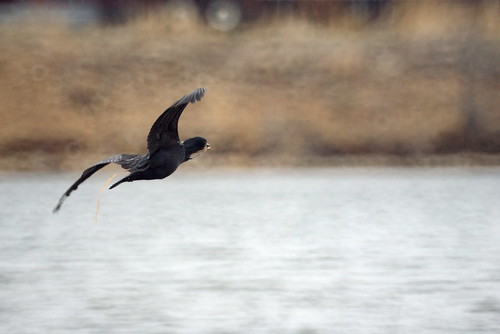
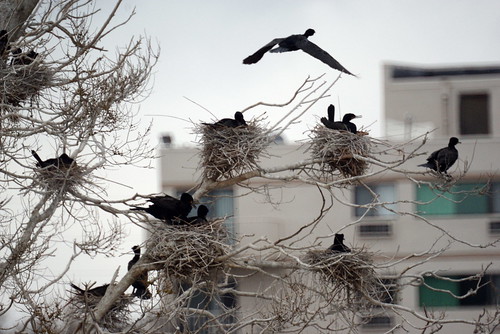
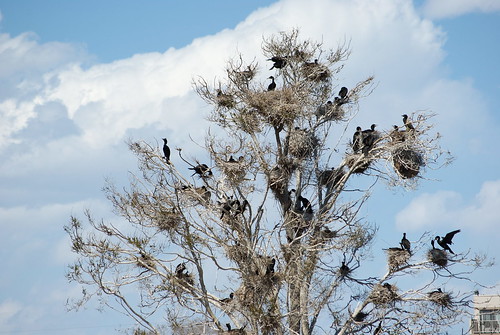
I am sure cormorants have been around here longer than I have, but this year is the first time I've noticed them, or knew what they were. A whole flock has taken over a tree on a pond at Prospect Park:


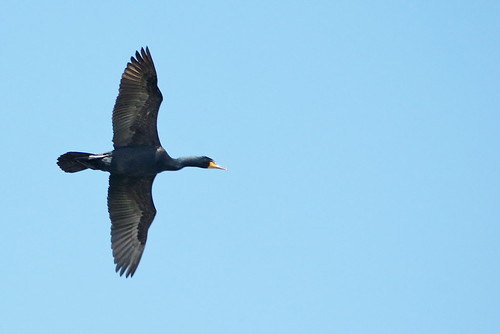
They use the tree as a launching pad for excursions to feed and to collect nesting materials:


The way they are building a network of nests in the tree reminds me very much of the condominium building visible behind the tree:


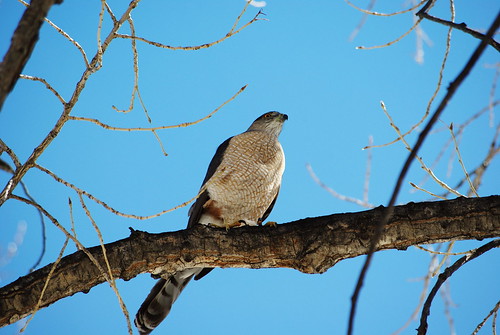
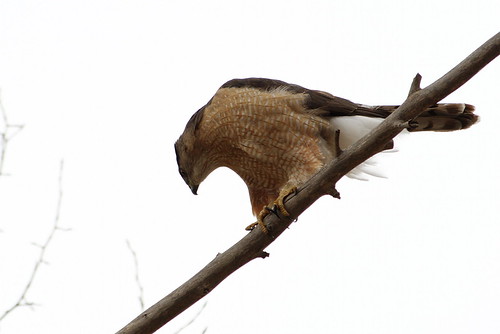
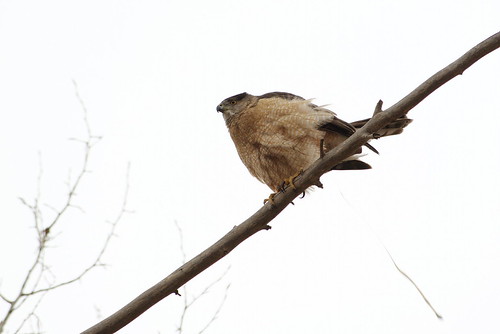
One day while my wife Wendy and I were watching and photographing the cormorants, a couple of birdwatchers came and told us where we could find a hawk in a tree elsewhere in the park. We were a bit skeptical that it would still be there when we got there, but there it was:


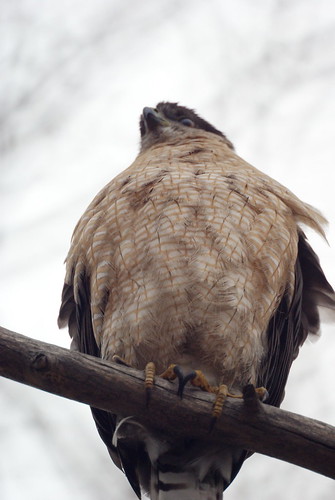
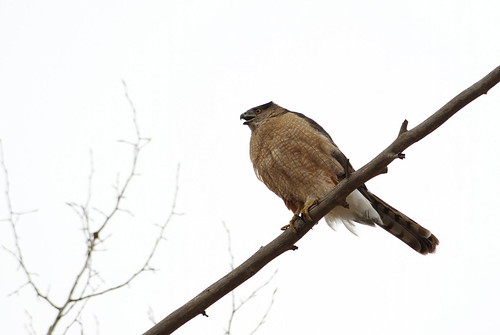
We thought we were lucky to get off a couple of shots, as we were sure it would fly off at the sound of our shutters. But it turned out this hawk was unflappable. We were able to photograph it from as close as we wanted:


On two separate occasions I watched and shot this hawk for probably an hour. It didn't do anything really dramatic, but I managed to catch a number of "moments", such as here when it might have found some prey:


Rather than dive and attack, it started calling out - perhaps to alert the other hawks in the area:


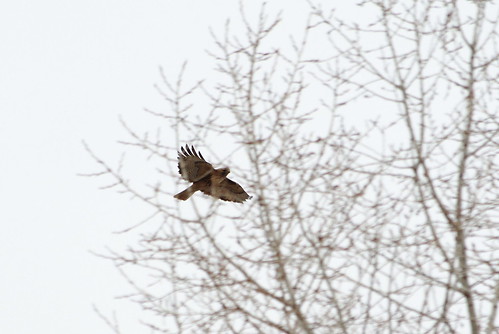
This bird was circling above us the whole time, but never came in any closer:


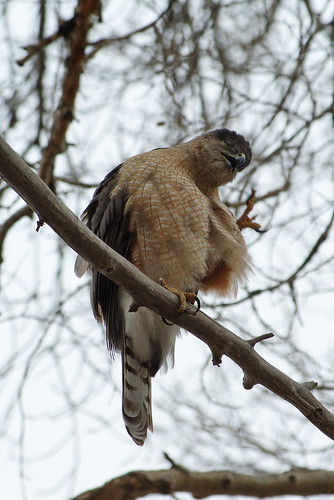
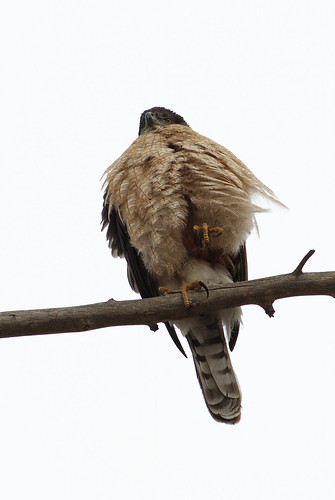
Eventually, my friend on the branch above me lost interest in whatever had commanded its attention, and went back to more mundane activities, such as scratching its head:


At one point it shifted position and lifted its tail and I was sure it was going to fly off, but all it actually did was poop:


When the wind blew, it would have to do something to keep its balance. In this instance, it apparently decided it was best off balancing on one foot:


It was also a gust of wind that prompted the most dramatic pose offered by the hawk:


I have no idea how long this particular hawk will stay in the area, but I plan to visit as often as I can, as this was just an amazing experience.

Saturday, March 7, 2009

Returning To The Scene

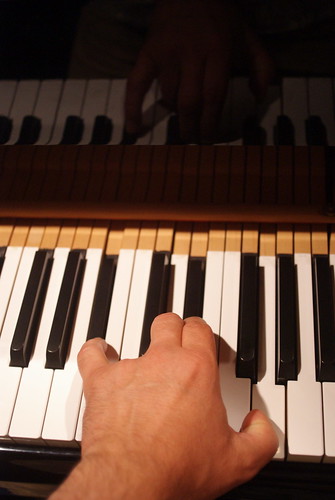
As some of you know, I played the piano at a jazz club in Denver called El Chapultepec (aka "the Pec") for a number of years, ending back in July. I hadn't been back since - not because there were any hard feelings, but simply because there hadn't been any particular reason to visit. A few days ago, the saxophonist I had worked with most of those years - Keith Oxman - suggested we meet there and visit. OK, and also to see about maybe playing there again. When they ended our run last summer, they decided not to have anyone there on a steady basis any more on weekend nights but instead to bring in different bands each night, as most clubs do. No particular reason we couldn't be one of them!

So we dropped by last night. It was great to see the owner Angela, the bartender James, and the rest of the crew again. The band du jour was led by trumpeter Hugh Ragin, who was the first musician I worked with regularly in Colorado, going back almost 20 years. This from last night:


BTW, that was shot at 1/6". I was able to rest my elbows on a countertop, so you can't credit me or Pentax shake reduction too much for the lack of camera shake. But for the lack of subject motion blur, you've got to credit Hugh, who has one of the most relaxed trumpet techniques you're ever likely to see.

They've made some cosmetic changes at the Pec over the last few months. Nothing really major - some faux brickwork behind the stage, new carpet in the dining area, etc. But one of the most immediately noteworthy changes was the lighting. At least the way they had it set last night, it was still as bad as ever toward the front of the stage where Hugh was. But the light on the piano was a *lot* brighter and cooler than in the past. Actually, I think it mostly came from a neon beer sign, but light is light. In this shot of pianist Ron Jolly, it's hard to recognize it as the same place, as anyone who has tried to shoot there will attest:


Keith and I sat in and played a tune or two. No pictures of me, of course, but here's Keith, pretty much back to 100% after his bout with cancer:


On those last two, I'll take some credit for good timing in getting reasonably sharp pictures at shutter speeds of 1/20" and 1/15" respectively :-)

Oh yeah - we did talk to Angela, and she's more than happy to have us back from time to time. I think playing there on an occasional basis will be great - it will be more likely that we'll be able to get people to show up to hear us as opposed to just depending on the people who happen to drop in as we always had (it's the busiest neighborhood in the city). So hopefully I'll be seeing some of you there at some point!

Monday, February 16, 2009

Rene Marie - Voice of My Beautiful Country

Many of you have probably heard of Rene Marie, whether you remember it or not. Jazz fans may know her from several recordings she did for the MAXJAZZ label. But beyond the jazz world, she had her additional "fifteen minutes of fame" in the United States at large last year when she sang at the Denver State of the City address. She had been invited to sing the national anthem, but she chose to use her own arrangement of the song in which she superimposed the words of the patriotic spiritual Lift Every Voice And Sing over the melody to The Star-Spangled Banner. That caused quite a stir and was a hot topic for a while on talk radio and political commentary nationwide, as some people took great offense at this.

Before I go any further, I should disclose that I know Rene and consider her a friend. Not so close that I think I can speak for her, nor so close that I imagine she would particularly care what I think. But close enough to be confident that she would encourage me to be honest just as I believe she has been.

If you're looking for insight into why Rene made the choice she did, you can read the statement she released on her web site some time ago. Frankly, the State of the City story is old news. What I really want to share is my reaction on hearing the piece - and the whole three-movement suite of which it is a part - performed in full last week at an event honoring the 200th birthday of Abraham Lincoln. However, to the extent my feelings were informed by the events of last year, and since the story from my perspective does start with the State of the City address last year, I'll begin by saying a few words about the earlier event.

I was not present at the State of the City address, but like most people in Denver, and many around the country, I heard about it after the fact. My feelings at the time were probably what a lot of people thought: that it was an a very odd thing to choose to do, but also not worth getting as worked up over as some people were getting. I mean, on one hand, she was asked (albeit apparently not being paid) to sing a song, and she responded by singing a somewhat different one: same melody, but different lyrics. A questionable choice, to be sure. On the other hand, consider that a good number of performances of the national anthem have no lyrics at all (eg, every time it was played at an Olympic award ceremony last year). So it can hardly be claimed that omitting the original lyrics was a travesty in itself. Furthermore, the lyrics she used instead can not reasonably be said to be inappropriate for a civic function:
Lift every voice and sing,
'Til earth and heaven ring,
Ring with the harmonies of Liberty;
Let our rejoicing rise
High as the listening skies,
Let it resound loud as the rolling sea.
Sing a song full of the faith that the dark past has taught us,
Sing a song full of the hope that the present has brought us;
Facing the rising sun of our new day begun,
Let us march on 'til victory is won.

Liberty, rejoicing, faith, hope, victory - these are the themse of practically every patriotic song ever written, including The Star-Spangled Banner. It is not like Rene was singing "kill whitey" or "death to the infidels" or any such nonsense, as one might have surmised from the vehemence of the reaction by some against her.

To the extent that there was anything wrong with her choice, it really just had to do with the idea of meeting expectations - and expectations that have particular meaning to a lot of people. Now, as a jazz musician myself, I know that the notion of surprise is one of the defining elements of the genre. It is the basis for the appeal of improvisation. I would hate to be called to task every time I have substituted a Db7 chord for a Gmi7. On the other hand, I don't need to be told that there are certain liberties one might be "expected" to take, and others one might not be. As far as I could see, Rene may have crossed a line, but it was hardly a line between black and white (in any sense of the words), nor did she cross it very far, and I don't really see why people took so much offense.

Even among people who were trying to be civilized in their criticism, I thought one comment in particular was off-base: the comparison to a house painter being hired to paint your house green but responding by painting it red instead. There are two major flaws in that analogy. One is that no money was involved. And the other is that if someone paints tyour house, that is something you have to see every day until you pay someone to paint it again. There were - or should have been, I thought - no similarly lingering effects from a song. No money wasted, no real harm done.

As far as I was concerned, that was all there was to the story, until I heard Rene speak about it last week at the Lincoln's birthday celebration and then perform the full suite of which her arrangement of Lift Every Voice And Sing / The Star-Spangled Banner was a part. The event was held at St. John's Episcopal Cathedral in Denver, and it featured Dr. Vincent Harding, an associate of the Reverend Dr. Martin Luther King Jr., moderating a "dialog on race and the future of America." If you do read the statement on Rene Marie's site, you'll have a pretty good idea of what she said last week, but her remarks in person went a bit further in explaining the background behind how she came to write the suite. At the risk of perhaps getting some minor details wrong, I will try to summarize her story, while relating it to my own experience.


Rene began by talking about being in Russia on a concert a few years ago. A reporter who was interviewing her referred to her an American, and that took her aback slightly. She sad that this got her thinking about why she felt that way, because it was not that she was not American, or that she was ashamed of being an American. As she shared her own thoughts on this, my mind turned its attention to my own feelings.

My sense is that one identifies oneself in various different ways, but any time one belongs to an minority group, that identify is often stronger than others. For instance, I am a visual artist. Right now, I paint mostly in oils, but I do not necessarily identify with other oil painters specifically. However, when I was primarily a pastelist, I identified with other pastelists to a much greater extent. I joined the Pastel Society of Colorado, entered pastel-only competitions and exhibitions, and so forth. I think this is because oil is one of the dominant mediums in the world of visual art, where pastel is definitely a "minority." Or, as another example, I am a photographer, and as such have a certain connection to other photographers, but I feel that connection much more strongly among that minority of my fellow photographers who shoot with Pentax gear. I do not sense the same type of camaraderie among the people I know who shoot Canon or Nikon, and I think that is because they dominate the market and Pentax is little guy in comparison. I also suspect the jazz community of which I am a part is more tightly knit than, say, the pop/rock community.

Being a pastelist in a world of mostly oil painters, or a Pentax shooter in a world of mostly Canon/Nikon shooters, or jazz musicians in a world of mostly pop/rock musicians, gives me a certain sense of identity. As a white person living in America, I can't say I feel any special identity that is associated with being white or with being American. My sense of identify as a pastelist or Pentaxian or jazz musician is far stronger than my identity as a white person or as an American. If I were black, I could see that part of my identity being correspondingly stronger. But white or black, I would be surprised if an interviewer here in America referred to me as an "American," as if that were a significant part of my identity here. After all, virtually everyone I encounter in my daily life is an American too. You might as well refer to me as a ten-fingered person. And merely visiting another country does not change my self-identity. Regardless of where I am located at the moment, my identity as a pastelist or Pentaxian or jazz musician would seem more significant to me than my identity as an American.

Now, none of this is what Rene Marie was talking about. It is how I related to what she was talking about. What she was talking about was not just the irrelevance of her identity as an American, but also how it seemed somehow in contradiction with other aspects of her identity (not that she put it in those terms), even though of course she is an American. But like all black Americans, she has had to reconcile her identity as "black" with the reality of living in a country in which her ancestors were enslaved because of that identify, in which her parents were not allowed to eat at certain lunch counters or attend certain schools because of that identity. It is possible to be American and to love America even while living with that contradiction, and that is what she spoke about.

As she related, she grew up singing both "The Star-Spangled Banner" and "Lift Every Voice and Sing" and enjoying both. But the former was specifically about a war that was fought at a time when her ancestors were still slaves; it was about a flag that flew over buildings that her ancestors were not allowed to enter. As such, what I think I heard her saying was that it was harder to relate to as a child, even though she enjoyed singing it and loved what the country had become since then. "Lift Every Voice and Sing," however, resonated more strongly with her from the beginning, speaking as it does about the ideals of the faith and liberty.

It was thoughts on these topics - even if I have taken the liberty of personalizing some of those thoughts - that prompted Rene to want to write a suite of patriotic music that reconciled her identity as "black" with her identity as an American. So she took the lyrics to two patriotic songs - "America the Beautiful" and "My Country 'Tis of Thee" and set them to her own melodies. The music, I think, came from her identity as a black person and from her Christian upbringing; they are essentially gospel melodies and harmonies. I think that fusing "Lift Every Voice and Sing" and "The Star-Spangled Banner" would have been a similar reconciliation of these two identities that are, of course, not actually in contradiction at all.

With all these ideas floating in my head, and the spectacular surroundings of the cathedral itself, it was a sublime setting to listen to the music. Of course, everyone present knew enough of the backstory that there was no question as to the appropriateness of this arrangement in this situation. And the musicians accompanying Rene - Jeff Jenkins on piano, Mark Simon on bass, and Paul Romaine on drums - are among the top players in Denver (which is saying a lot).


I have heard Rene perform in other venues and know her to be a world-class musician, but the impact of this performance was on another plane entirely. It was inspiring, uplifting, healing, mesmerizing, exciting, creative, and beautiful all at once. I think it safe to say that it would have been difficult for anyone - even her critics - not to have come away stunned in the most positive sense of the word. I don't know if she recorded this performance or not, but you can hear a studio version on her site.

Saturday, January 17, 2009

Fred Hess Recording Session

Earlier this month I had the pleasure of taking part in a recording session by the Fred Hess Big Band. Fred's music is always a fun challenge to play, but spending the better part a whole week in rehearsals, a concert, and of course the recording itself added a new human dimension. Instead of struggling on my own to get my own parts down, showing up for the gig, playing the tunes once with a handful of musicians, and then going home, it was an experience shared with at least 17 other people and lkely to be remembered by all of us for a long time.

It started with a day of rehearsal. Fred's charts are very complex and require a fair amount of explanation:


Tyler Gilmore of the 9th & Lincoln Orchestra served as conductor, so Fred could concentrate on playing. Tyler was the glue that held the whole thing together:


However, Fred led the band during our reading of his infamous "The Clefs Visit Grandma's". I suppose the most relevant thing I can tell you about this chart is that the idea of me getting up from the piano and taking a picture in the middle of the performance was not out of character for the piece:


One of the highlights of the week - and indeed, of my whole career - was working with drummer Matt Wilson and bassist Ken Filiano. As is the custom during most recording sessions, both Matt and Ken were in an isolation booths:


This was a little disappointing, as part of what makes a rhythm section work is close communication, and that's difficult when you can't even see each other. Luckily, the gig we did at Dazzle that week was another story entirely, and that was magical:


Matt and Ken have been Fred's recording and NYC rhythm section for several years now and know his music pretty well, but Ron Miles has an even longer history with Fred. Working with Ron was another highlight for me. Although we have performed together several times before, and both Ron and I have recorded with Fred individually, this is the first recording Ron and I have been on together.


Here are a few of final shots, of the saxophone and trumpet sections and of engineer Colin Bricker:


Thursday, December 4, 2008

Hymn For Peter

Dedicated to Peter Fopeano (1965-2008)

Listen to a (simulated) orchestra playing my composition, "Hymn for Peter"

My wife Wendy's family has a large Thanksgiving gathering every few years, with relatives coming in from all over the world. Although he would sometimes make the trip for part of the time, her youngest brother Peter was never able to be with us on Thanksgiving day itself, because he worked at a casino and Thanksgiving was one of their busiest days of the year.


Peter lost his job earlier a few months ago, and while that is seldom a good thing, one silver lining was that he was going to be on Thanksgiving for the first time in many years. Although this year was not going to be one of the large worldwide gatherings, my wife and I made plans to fly out to Kansas City to celebrate with her immediate family, and Peter in particular.

The morning before we were to fly out, we received news that Peter had been shot and killed while sitting in his car - an unintended victim of crossfire between rivals standing on either side.

Needless to say, our trip to Kansas City took on an entirely different meaning, as our celebration was tempered by mourning. I do not think I can express my feelings about all this in words here in this blog. However, on Friday - the day after Thanksgiving - I had time to sit alone with my thoughts for some time, and not surprisingly, I turned to music for release. I decided to write a composition to perform at Peter's memorial service.

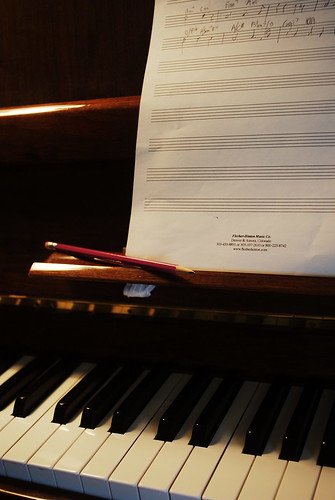
The idea started as a simple tune that I would play on the piano and embellish with improvisation in my usual manner. My model was Don Pullen's Ode to Life, which is a jazz piece that incorporates improvisation but has a classical feel to the composed sections. Because I wished to be alone, I did not compose at the piano (which was in the dining room), but rather in silence with pencil and paper only, in the bedroom where Wendy and I were staying. While this is not my norm, it is not something I have no experience with, either - I composed away from the piano often when I was writing in a classical idiom as part of my degree.

Perhaps for these reasons, when the first few phrases came out of my pencil, I realized I was writing not a jazz tune at all, but a hymn. After writing the basics of the melody and harmony for the first section of the piece, I turned my attention to arranging it in traditional four-part chorale harmony. I think wrote a second section for the piece and arranged it similarly. At that point, I had a completed hymn, but not a clear idea of what I would do with it.

Since I was not at the piano, and I had my computer with me, I entered my hymn into Finale, the scoring software I have used for years, so I could hear it, edit it, and then print it out. At first, when I hit the playback button to listen to the results, it played using the default piano sound. But at some point I started thinking about what it would sound like if it were sung - even though I had not (and still have not) written any lyrics for this. So I changed the sound to a sample of a choir singing "oooh" and "aaah". Although I can't say the results were impressive in themselves, it immediately struck me that the piece really needed to be scored for some sort of instrumental ensemble. The most obvious choice seemed to be a straight rendering of the four-part SATB harmony into the instruments of the quartet: two violins, viola, and cello. I set this up in Finale, and then started considering how I might put together a quartet or even a small string section (with multiple players per part) to record this during the week between then and the memorial.

By the next day, however, it occurred to me that I really wanted to hear how it would sound with a full orchestra. I knew there was no way I could get an actual orchestra lined up to play it such short notice (and indeed, it would be difficult even with no time constraints). But I also know that Finale comes with some fairly high-quality orchestral samples - ones that are often used in film scoring. So I spent most of Saturday and Sunday working on an orchestral arrangement of my hymn.

What I ended up with is a pretty faithful rendering of the original SATB chorale harmonization, using the different colors of the orchestra to add variety, as opposed to actually creating new harmonies and so forth. Over the last few days since returning to Denver, I have continued to tweak this, and while I suspect I'll continue to do in the future, I think this at a place where I would like to share it. So if you have not already clicked the link at the top of this entry, you can do so now.

The memorial service is Monday in Kansas City. I still have not decided if I am going to simply play this on the piano as per my initial plan, or use this recording, or use a recording of a real string quartet that I still plan to try to make between now and then. I may well decided to play it myself, since that in some ways is the most personal expression I can put forward at the service. As a composer, my orchestral arrangement is at least as personal to me as my own playing. But of course, this is not about my relationship to the music - it's about expressing my feelings about Peter.

Peter, this is for you.

Monday, November 17, 2008

Concert Photography - Equipment

I do a lot of writing, a lot of teaching, and a lot of concert photography. So I figured it was time to combine these activities and write up some advice on shooting concerts. This first entry will deal with equipment. There is also a second article on technique, and now a third on post-processing.

Light



Let me start by telling you what kind of advice you won't get here: advice on using flash. That's for a different blog, one perhaps entitled "how to annoy musicians and fellow listeners while ending up with pictures that fail to capture the original mood of the event". OK, that's a little harsh - flash can be effective and useful for certain effects and in certain settings, but it's just not what I do.

Instead, we're going to be talking about available light photography. For outdoor concerts, life is pretty simple, but not so for indoor concerts. While the lights on stage may seem bright in comparison to the dark of the club or hall, they usually aren't very bright by photographic standards. So we're talking about low light photography. This means shooting at relatively high sensitivity (eg, ISO 400, 800, 1600, or even higher) in order to get shutter speeds fast enough to avoid blur. Many of the techniques we'll talk about involve dealing with these issues.

Camera

Now, it is certainly possible to shoot concerts with film cameras, and obviously, people have been doing this for much longer than they have with digital. Most of the advice I give will be similar between film and digital, but I will be focusing on digital, since that is where most of my experience is. In general, you're best off with a digital single lens reflex (DSLR), as they are able to shoot at higher ISO values with lower noise (graininess). So the rest of my comments assume you are using a DSLR. As of this writing, I use a Pentax K200D, which has more than adequate noise performance, even when forced to underexpose at ISO 1600, as is often the case. It also has built-in stabilization, which allows me to shoot at lower shutter speeds than I otherwise might. Stabilization is discussed further below - in the section on lenses - because on other camera systems, stabilization is a function of the lens, not the camera.

Of course, some "point and shoot" (P&S) cameras are also capable of good results if you know how to use them to their best advantage. The controls are often different, but if you understand how they work, you may be able to make use of much of the advice I will give on using a DSLR. And even though you cannot change lenses as you can with a DSLR, the discussion on lenses below might be useful in choosing a P&S camera, as you not only want good high ISO performance, but also a lens that will do the job for you, since you won't be able to change lenses later.

Your camera will need to provide manual exposure controls of some kind. I prefer the fully manual "M" mode, but creative use of exposure lock, exposure compensation, and other controls in an autoexposure mode can be just as effective.

Lens

There are two critical factors in considering lenses for concert photography: focal length and maximum aperture. Aperture is easy: basically, you want the biggest maximum aperture (ie, the lowest f-number) you can afford for the focal lengths at which you will be shooting. That is because larger apertures translate into faster shutter speeds, and in low light, we are constantly struggling to get fast enough shutter speeds to combat both camera shake and subject motion. Indeed, lenses with large maximum apertures are often called "fast" lenses, because they allow fast shutter speeds. "Slow" lenses with a maximum aperture slower than f/4 are essentially useless, and you really want f/2.8. You might think that f/2 is even better, and sometimes it is, but not only do lenses get more expensive as the maximum aperture increases, but they also get bigger and heavier, and for telephoto lenses, this can be a very significant factor. Also, f/2 is not always practical for concert photography because the depth of field is so small - it can be impossible to get a musician and his or her instrument to both be in focus. So f/2.8 is kind of a standard maximum aperture to shoot for. The f/2 lenses are more of a special luxury except at certain focal lengths like 50mm where you can get relatively small and inexpensive f/2 lenses quite easily.

Focal length is the more difficult consideration in choosing lenses, as this is more subjective, and it probably is not the case that one focal length will suffice. Most photographers these days are accustomed to using zoom lenses, which provide a range of focal lengths, so to some extent, the decision is easier than if you had to choose a single focal length. The advantage of a zoom, of course, is being able to take both wider angle shots and more close-up shots - and everything in between - from the same location. The downside is that f/2.8 zooms tend to be fairly expensive as well as large and heavy. Zooms faster than f/2.8 are practically non-existent, and they are even more expensive, large, and heavy if/when you do find one. So prime lenses - ones with a single focal length - still have their places.


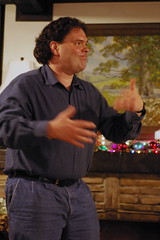
As is the case with the guitar player here, many of my concert photographs are basically head-and-shoulder or upper body portraits with instruments. These are the sorts of images musicians like to use as "action shots" in their promotional materials. I suppose I gravitate to these because I am a musician myself. And as you have probably gathered my now, my main interest is jazz, so I am dealing with clubs rather than auditoriums. I tend to shoot from a table in the front at a club when possible, so I am usually only a few meters away from my subjects.

To get these kinds of shots at these kinds of distances, a focal length of around 100mm is just about perfect. My most used lens is the manual focus Pentax-M 100 f/2.8, henceforth referred to as the M100/2.8. This is what I used for the guitar player at left, for example. Note that my camera has a 1.5X "crop factor", meaning that 100mm is the equivalent of a 150mm lens in terms of what would produce the same field of view on 35mm film. Most DSLR's are similar in this respect, but be sure to know the equivalent crop factor for your own camera if comparing focal lengths to mine.

If I cannot get close to the front in a club, or if I am in a larger auditorium and have to shoot from further back, I will use a longer lens, but the further back I am, the lower the expectations I have regarding the results. I have a manual focus 135mm lens (maximum aperture f/3.5) that works well for me when I am not in the very front, and a manual focus 200mm f/4 lens that I will use on rare occasions when I know I will be really far back but still want to try to take pictures. I have also used a 135mm lens with a 1.4X teleconverter to yield the equivalent of a 200mm lens that is one f-stop slower, but I'm not sure this does better than simply cropping the image from my 135mm lens without a TC. In some larger auditoriums I have even used a basic cheap 50-200mm zoom lens with a maximum aperture of only f/5.6 at the long end. The good news is that stages in large auditoriums also tend to be better lit than in small clubs, so f/5.6 might be fast enough. This is also the lens I used most for outdoor concerts during the day.

Here are some samples to show how these focal lengths work. First, another shot from the front row with the M100/2.8:



And this one from just a little further back with the M135/3.5:



This one was in a larger auditorium where I was perhaps 20 rows back. The stage was lit well enough that was able to use the DA50-200/4-5.6 zoom at 200mm and f/5.6:


There are 70-200/2.8 zooms available for most camera brands, and these are quite popular for concert photography. This focal length range worked well for 35mm film, but on cameras with a "cropped" sensor, I find these lenses unnecessarily large, heavy, and expensive (the better part of $1000, and that's without stabilization). Pictured here is a Nikon version:


If you're serious enough about concert photography to consider buying such a lens, you are probably serious enough to go out of your way to position yourself close to the action so that you don't actually need the 200mm end very much. In situations - like sitting 20 rows back in a large auditorium - where you might you feel the need for 200mm and f/2.8, you'll probably find a 70-200/2.8 too large to deal with if there are other people sitting next to and in front of you. On the other hand, if you're at an outdoor concert during the day, you might want 200mm, but wouldn't need f/2.8.

The upshot of this is, I think most people are better off with lenses a bit shorter than 70-200mm as their main concert lenses. A 50-135/2.8 or 50-150/2.8 zoom is not necessarily much cheaper than a 70-200/2.8, but they can be significantly smaller, lighter, and easier to handle, and I think these are more useful focal length ranges for concert photography on a camera with a 1.5X crop factor.

Still, even a 50-135/2.8 lens is over twice the length and three times the weight of my M100/2.8. In fact, the M100/2.8 is even smaller than the cheap 18-55mm zoom lenses that most DSLR's are packaged with. Lens size and weight may not matter to everyone, but smaller lenses do help me feel less self-conscious about taking pictures from the audience, and they make the camera easier for me to handhold. Throw in the fact that one can buy an M100/2.8 for under $100 and you can see why I recommend it so highly for Pentax users. But I am not sure if anything comparable exists for other brands. I think Canon and Nikon owners would do well to look at the 70mm, 90mm, 100mm, or 105mm f/2.8 macro lenses, or the 85/1.8 or 100/2 lenses, that are available for these systems.

But at around $400 for a single focal length, these are getting expensive enough that many folks may decide that a more versatile 50-135/2.8 or 50-150/2.8 is worth the extra money to cover their telephoto concert needs. Certainly if I were a full-time professional, the lens would pay for itself easily, and I would appreciate the flexibility if I were under pressure to get a certain number and range of pictures. With primes, sticking to one focal length is a little limiting, but changing lenses often can be a hassle. For my purposes, a couple of primes that I change only occasionally meets my needs.

Of course, if you're looking to capture full body shots, or wish to include more than one musician in the picture, you'll need a correspondingly shorter focal length. In that case, something like a 50-135/2.8 zoom can make more sense than a longer prime. Or, you can do as I do, and bring a shorter focal length prime as well. I usually bring my DA40/2.8 "pancake" (which takes virtually no space in my bag and runs only a little over $200), although sometimes I will instead bring my manual focus A50/1.7 (also quite small, and well under $100) if I feel I might need something faster than f/2.8. I also have a DA70/2.4 to give me yet more options. But I rarely take more than two of these lenses with me, I decide based on the venue which two to take.

The 50mm focal length is worthy of special mention if for no other reason than the fact that this is usually the first "fast" lens people buy - often as fast as f/1.4. While 50mm is shorter than I usually prefer, you can always crop the results to resemble those from a longer lens. And 50mm can be an interesting focal length in itself:


However, 50mm or even 40mm on a "crop factor" camera is not usually wide enough for shots of a whole stage. For that, depending on the size of the stage and how close you are, you might need 28mm, 18mm, or even shorter. If you move back from the front row, then you don't need such a wide angle lens, but then you usually find the people in front of you end up in the photo, too, which you may not want. I normally have my M28/2.8 (under $50) with me, although I rarely use it for concert photos, because I normally prefer taking more closeup pictures. But here is an especially small stage where 28mm was just barely wide enough to fit all four musicians in:


For people who take many shots like this and are not as interested in getting as close as a 100mm lens would allow, a 28-70mm, 28-75mm, or 24-70mm f/2.8 zoom lens can make for a nice compromise. With these, you can capture both semi-wide angle shots like above as well as semi-closeup shots, and these lenses are not terribly large or terribly expensive ($400) considering their versatility. While 70mm is not really as long as I would like, it's still enough to isolate individual performers and show them in some detail. You can certainly do quite well with such a lens.

Of course, no one is limiting you to just one lens. A 28-70/2.8 plus a 105/2.8 macro and perhaps a very inexpensive 50/1.8 would cover your needs better than a 70-200/2.8 for roughly the same price. For the record, I usually have three lenses with me: either the M100/2.8 or M135/3.5, either the DA40/2.8 or A50/1.7, and the M28/2.8. I rarely feel constrained in any way with these.

There are two other considerations worth mentioning here in choosing lenses.

One is focus. Pentax users are in the enviable position of having access to a great many used manual focus lenses that work just fine on our cameras. My M100/2.8, A50/1.7, and M28/2.8 lenses cost me around $200 combined. Auto focus is often slow and/or unreliable in low light, and it is also easily confused by the instruments, microphones, standards, and other paraphernalia on stage. So if you can save money by going with used manual focus lenses, that is worth thinking about.

The other consideration is stabilization. Dealing with the slow shutter speeds we are often faced with in concert photography, stabilization can be a very useful thing. With some camera systems, stabilization can be built into the lens. Although it costs more for a stabilized version of a lens versus an ordinary one, it can be worthwhile. At a focal length of 100mm and a shutter speed of 1/30", stabilization can make the difference between having most of your shots come out acceptably sharp and most of them ruined by camera shake. Here, Pentax users have the advantage of having stabilization built in to the camera, meaning that all of our lenses - even a used manual lens you find for $20 in a pawn shop - end up being stabilized. On the downside, lens-based stabilization is generally claimed to be somewhat more effective.

Still, any stabilization is far better than none, so I think in-body stabilization is more practical for most people. Both Canon and Nikon make stabilized 70-200/2.8 lenses, which may be one reason these are popular with professional concert photographers despite being quite expensive (around $1500) and longer than usually necessary for most people. But realistically, most beginning Canon and Nikon concert photographers will probably have to pass on the benefits of stabilization for concert photography, as only the slower lenses are available in stabilized form at an affordable price. And while stabilization allows you to take shake-free photos at slower shutter speeds than you would otherwise, slow lenses won't allow fast enough shutter speeds to freeze subject motion.

Other Equipment

Aside from the obvious - camera and lens, perhaps spare batteries and memory cards - there really isn't a whole lot else you might need.

Since we're dealing with low light and slow shutter speeds, a tripod might seem a logical tool. In practice, I find dealing them too distracting, and indeed, they usually aren't allowed at most venues. A monopod can be a reasonable compromise, however. But I usually do well enough simply bracing myself against my chair or a post, and with the shake reduction provided by the camera, I usually find subject motion more of a problem than camera shake.
Saturday, November 15, 2008

Inspiration

As a person involved in so many creative endeavors - music and art most obviously, but also photography, writing, and even my approach to cooking and other activities - the subject of "inspiration" comes up fairly often. As in, where does my inspiration come from. That is a difficult question to answer, but I would like to share a few thoughts on the matter.


My main occupation is music - specifically, jazz. One of the unique things about jazz is that, compared to other forms of music, one is almost constantly creating. Improvisation is the heart and soul of jazz. In a typical performance, probably 95% of what I play is improvised. This means that each time I play a gig - as I do usually a couple of nights a week on average - I am coming up with several hours' worth of music I have basically never played before. Sure, I am building on foundations that have been laid down already, but most of the specific melodies I play really are created on the spur of the moment. I am accustomed to not waiting for "inspiration" to strike me as if this were an unusual event. I no more require "inspiration" in order to decide what note to play next than I do in order to decide when to take my next breath.


This is in fairly stark contrast to a classical musician practicing a piece over and over so he can perform it pretty much exactly the same way every time. But more importantly, it is also quite different from the image of, say, a writer staring at his typewriter for days on end waiting for a word or two to come out. I come closer to this situation when I am composing, as opposed to improvising, music. Although I know from experience that I can generally compose a tune any time I sit down and put my mind to it. I have not tended to do this very often, but for a while, when I had a regular weekly gig with my quartet, I was writing a tune a week.

For a long time, painting was somewhat similar for me. Virtually all my paintings are landscapes, and virtually all done on location (en plein air). I would make a commitment to myself or a friend or a group (such as a class I might be taking) to show up at a particular time and a particular place and paint whatever happened to present itself that day. I might wander around for a few minutes to find something I liked, and think some about the vantage point that would produce the best composition, how to frame the scene, and how I would approach the painting. But overall, the feeling was almost as automatic as improvising music: just about any time and any place would do, and I would find something to paint as surely as I would find a phrase to play when improvising in jazz.


A couple of weeks ago, however, I hit a point of temporary crisis. I had met a friend to paint at a location we had been to several times before. Very nice scenery, with a river, trees, some interesting old buildings - everything that would normally get me going.


On this occasion, though, I simply could not get inspired. I wandered about with my camera as I always do, taking "test" pictures of various subjects and checking them out on the screen to see if I thought they would make good paintings. Many shots looked perfectly usable, but the overall sense I had was, "been there, done that."


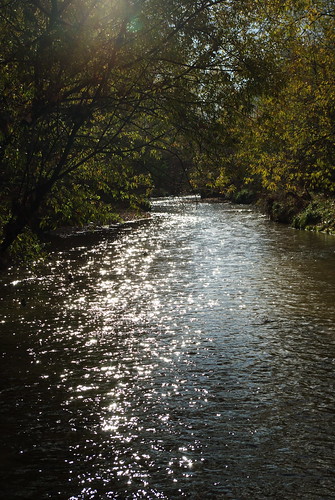
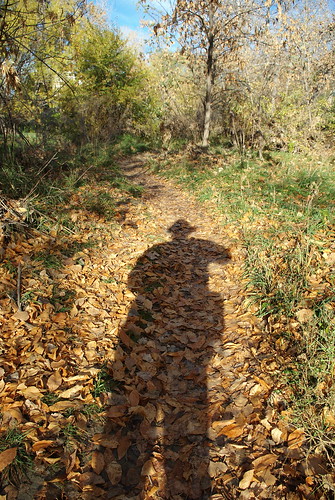
The only two shots I took that excited me were shots that were almost totally unpaintable. Or at least, they could not easily be painted on location. The image at left depended on a quality of light that was not going to last but a minute. The image at right (below) depended on the length of my shadow, which was going to get shorter and shorter the longer I worked - plus the shadow of my easel would have become part of the picture. It would not have been impossible to work around these issues, but now that I had the photographs, I felt no need to go to that much trouble to recreate them as paintings.


I actually considered giving up for the day, as I had been walking in circles for over an hour. But instead, I decided to embrace the idea that inspiration is, or at least can be, important. I still clung to the belief that it should be possible to find something to be inspired by, but accepted that I might have to look harder to find it. In jazz, I always feel I am better off eschewing the obvious and instead going for the less common, but this was one of the first times that the same feeling came over me in painting. I finally got tired - if perhaps only for a moment - of doing essentially the same painting over and over.


In the end, I found something that inspired me - a patch of tall grass that appeared to me like bamboo. In order to really capture what fascinated me about the scene, I sat on the ground on squatted low to give me vantage point where I would be looking up at the top of the grass. This is the type of "unusual" viewpoint that I always admire in photography but seldom think about in painting.

I set up my easel on the ground, too, and painted from this same position. Here is what I ended up with:


The moral? I am not sure. Like I said, I just wanted to share some thoughts. I welcome any comments you may have!